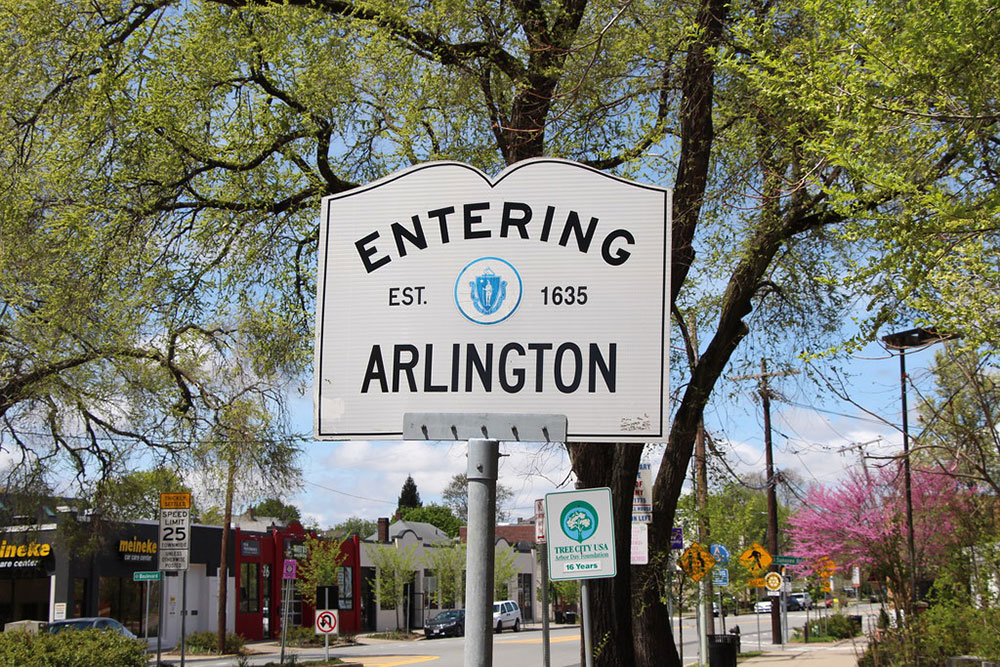
Arlington
Arlington, Massachusetts is a vibrant suburban community located about six miles northwest of downtown Boston in Middlesex County. With a population of approximately 47,000 residents, it ranks among the larger towns in Massachusetts while still maintaining the feel of a close-knit New England community. The town’s population was 46,308 at the 2020 U.S. Census and has gradually increased in recent years to around 47,100 residents by 2024, reflecting modest but steady growth.
Arlington sits in a prime location along the inner suburbs of Boston, bordered by Cambridge, Lexington, Belmont, Medford, and Somerville. Because of its proximity to the city, Arlington offers residents easy access to Boston’s job centers, universities, and cultural institutions while retaining a quieter residential atmosphere. Many professionals who work in Cambridge’s technology and biotech sectors choose Arlington for its balance of convenience and livability.
Historically, Arlington dates back to 1635, when the area was first settled by Europeans. Originally known as Menotomy, the community played a role in the early hours of the Battle of Lexington and Concord in 1775, when colonial militia clashed with British troops along what is now Massachusetts Avenue. Several historic homes from that era remain, including the Jason Russell House, which commemorates colonists killed during that battle. The town officially adopted the name Arlington in 1867, honoring the national cemetery in Virginia.
In the nineteenth century, Arlington transitioned from agriculture to small industry. Spy Pond, one of the town’s most recognizable natural landmarks, supported a thriving ice harvesting industry during the 1800s. Blocks of ice cut from the pond were shipped around the world, including to the Caribbean and India, by entrepreneur Frederic Tudor, sometimes called the “Ice King.”
Today, Arlington is known for its strong schools, historic neighborhoods, and active community life. The town has a median age of around 41 years, and many families are drawn by its public school system and proximity to universities such as Harvard and MIT in nearby Cambridge. The population is diverse and well-educated; roughly 18% of residents are foreign-born, and a large majority of adults hold college degrees.
Outdoor recreation is a major part of Arlington’s identity. The Minuteman Bikeway, one of the most popular rail-trails in New England, runs directly through the town and connects Arlington to Cambridge, Lexington, and Bedford. On weekends the path fills with cyclists, runners, and families enjoying one of the region’s best urban recreation corridors. Spy Pond, the Arlington Reservoir, and several neighborhood parks also provide opportunities for boating, walking, and community events.
Arlington’s town center features a lively mix of local restaurants, cafés, and small businesses. Massachusetts Avenue serves as the main commercial spine, with distinct neighborhood hubs such as Arlington Center, East Arlington, and Arlington Heights. Despite its relatively small geographic footprint—just over five square miles—the town maintains a strong sense of identity through civic engagement, arts programs, and local events.
Overall, Arlington blends historic character, urban accessibility, and suburban livability. Its rich Revolutionary history, active outdoor culture, and close connection to Boston make it one of the most desirable communities in the greater Boston area. For residents and visitors alike, Arlington offers the classic New England experience with modern amenities and a strong community spirit.
Sorry we are experiencing system issues. Please try again.